


In The Rite, horror creeps into the very institution meant to offer humanity peace — the Catholic Church, specifically, with everything it represents: ritual, authority, and a long history of confronting death, sin, and the unknown. From the heart of this tension emerges the relationship between Michael Kovak and Father Lucas: young, hesitant Michael, who enters the clerical world with a practical mind and mounting doubts, and Father Lucas, a priest worn down by years spent close to suffering until his faith became tinged with irony, fatigue, and caution.
Michael arrives at the seminary carrying deep hesitation. His choice of the priesthood seems tied to a complicated family history more than to any fully formed spiritual calling. Having grown up close to death, he now finds himself inside an institution that asks him to offer others answers about sin, fate, and the soul, while he himself cannot find stable answers to his own questions. His trip to the Vatican, then, is an extension of his inner crisis; he enters the world of exorcism to test the limits of what he believes, only to be confronted with events that threaten the very language he has always sheltered behind.
Michael functions as the viewer's eye within the film, standing between psychological and supernatural explanation, between the possibility of illness and the possibility of demonic possession, so that every scene becomes a test of the mind's ability to resist what unsettles it. He moves toward faith not through sermonizing but through an experience that puts his senses, thoughts, and fears face to face with phenomena he cannot fit into a single explanation. The character's strength comes precisely from this hesitation: he possesses no ready-made certainty, yet neither does he have the courage to simply deny everything that exceeds his own tools of understanding.
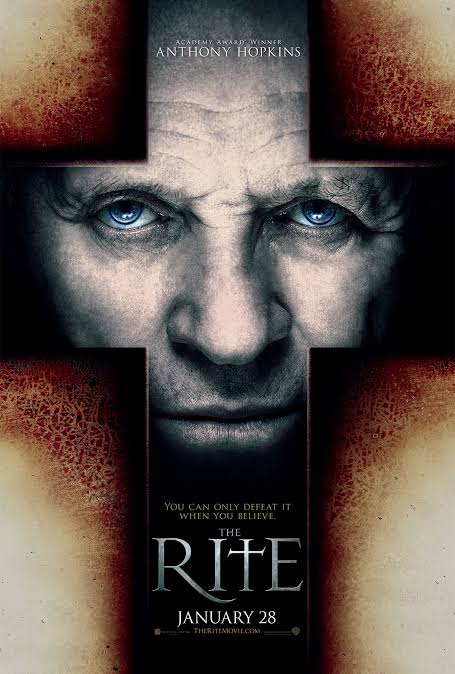
On the other side stands Father Lucas, the film's true heart. He first appears as an eccentric priest — sarcastic, sharp-tempered, and accustomed to handling cases that would break other men. But his strangeness reads as the residue of long years spent close to suffering, of an experience that made tragedy part of his daily routine, until sarcasm became his way of lightening the weight of what he knows, and humor became a mask concealing deep spiritual exhaustion. Anthony Hopkins plays the role with a presence built on contradiction: his voice carries the confidence of a man well versed in ritual and confrontation, while his eyes betray traces that belong to something other than confidence alone.
Father Lucas also represents a faith that has become a grueling daily practice. He carries the instruments of ritual, recites the prayers, and confronts cases of possession according to the Christian framework the film belongs to, all while retaining the features of a man who knows that ritual does not abolish fear. The viewer senses that every confrontation drains something from him, that every case reminds him that possessing religious knowledge grants no immunity from breaking down. His strength, then, seems to come from his ability to keep performing his duty under the weight of his own weakness, and from his capacity to draw close to the tormented even as he is being hollowed out from within.
The relationship between Michael and Lucas is the film's core. Michael wants an explanation the mind can trust, while Lucas deals with suffering before settling on its source. The young man initially sees in the priest an image of an institution that claims absolute knowledge, only to discover before him a man burdened with wounds, a man who draws his tools from the institution while simultaneously exposing its inadequacy. Through this relationship, the Church emerges as an entity caught between care and authority — possessing language, ritual, and records, yet standing helpless before individual experiences that exceed all procedure and classification.
The Rite succeeds more at building an atmosphere of the unseen and of evil than at offering a coherent vision of either. It is skilled at suggesting a hidden layer beneath the world, at turning churches, troubled bodies, and broken voices into signs of a presence beyond ordinary perception. Keeping Michael suspended between doubt and certainty also gives the story its dramatic tension. Yet this same suspension exposes the limits of the film's thesis: it places psychological and supernatural explanation in direct opposition, then makes confusion itself the main source of horror, leaving the truth suspended between an illness medicine cannot explain and a "demonic" force interfering with body and mind.
The film rests on a conception of the unseen that only appears when a person fails to explain a given phenomenon — as though the unknown only comes into existence through medicine's failure or the mind's confusion. Belief in the unseen, however, opens onto a more balanced space: it acknowledges the existence of what exceeds the senses while still keeping illness, disorder, and delusion within the circle of examination and verification. Our ignorance of a phenomenon's cause is not sufficient grounds for judging its nature, just as medical explanation does not exhaust everything connected to the human being and the soul. This is where the film's limitation becomes clear: it captures the collapse of the boundaries a person relies on to distinguish illness from the supernatural, truth from delusion, and what he sees from who he is — then leaves that collapse suspended in a space of confusion, without turning it into a responsibility to discern, or an awareness of the limits of knowledge.
The film weakens whenever it drifts away from this quiet tension and toward familiar horror clichés, letting its questions about institution, faith, and authority recede behind direct confrontation. Even so, it retains its impact because of Lucas as a character, because of the suspended distance between reason and experience, and because of its ability to turn the Church into a space of unease rather than reassurance.
The Rite's value remains rooted in its bleak atmosphere, in Anthony Hopkins' performance, in the tense relationship between Michael and Lucas, and in its transformation of the Church into a space where ritual sits beside helplessness, experience beside fracture, faith beside fear. The film succeeds in making the unknown palpable, in picturing the moment when human understanding narrows before what it cannot explain — but it falters when it turns that confusion into an end in itself, a mere engine of horror. The film is stronger at manufacturing a sense of the unseen than at building a coherent vision of its nature, and more convincing in portraying humanity's crisis before the unknown than in answering the unknown itself. For this reason, The Rite's real power lies in the questions it awakens and the world it creates, more than in the answers it offers.